
Here and now in Old Havana

A storm-soaked love letter to a city on the brink – and a farewell to the person I was there
Cuba is currently dealing with extended power cuts under a US-enforced fuel blockade which, combined with aging electricity infrastructure and chronic fuel shortages, caused the national electric grid to collapse on March 16. Read more about that here.
In light of this, I wanted to share this unpublished piece from May 2022 when I was in the eye of the biggest adventure I ever had: travelling from Cape Verde to Cuba to Mexico throughout several years of the Covid pandemic.
I’m in a moment of personal change that seems to be approaching its pinnacle in the form of post-viral fatigue. It’s as if the wild-haired wanderer who travelled the world writing about community-led adventure tourism for so many years has burned herself out and the new one is still cocooning.
While I believe those kinds of travel stories are still important, I’m not sure I’m the right person to tell them anymore. We are also at such an insecure moment geopolitically and climatically, tourism feels more complicated than ever in terms of its impact on host communities and ecosystems – and increasingly unpredictable for travellers.
The girl who wrote this story has vanished, and, if Trump carries out his threats of a ‘friendly takeover’, the Havana described here may soon change beyond recognition. This is a moment crystalised in amber, shared in tribute to both.
In a cafe on Old Havana’s San Rafael street, I chewed chocolate cake the consistency of talcum powder and waited for the storm to pass. As I drained my espresso, people tried to sell me things through the open window: jars of honey, rolls of film, a single flip flop.
J and C – Spanish sailors whom I had met in Cape Verde – were meant to be here when I arrived but I hadn’t heard from them for days. My messages weren’t delivering, so I assumed they were still on the sea somewhere between here and the Dominican Republic. At least, that’s what I hoped. The alternative was that they’d picked up some other girls in the Caribbean and blocked my number. I didn’t know a soul on this island and was struggling to navigate it with very limited internet and no Spanish. It had barely stopped raining since I’d arrived – dinner plate drops that shattered like grimy diamonds.
An old woman with most of her face concealed by a scarf murmured something to the barista. He pulled a cheese from under the counter which she whisked into a cloth bag. On her way out, she paused at my table and delivered an urgently whispered monologue.
Communism is the worst thing in the world. You think this is a private business but it’s owned by the government. Their spies are everywhere, she hissed. Cubans will show you pleasure, but never love. There is no love here. Her eyes widened as she slapped my coffee cup’s sticky footprint. You tourists bring the only money there is but you’re seen as enemies. The people will charm you but they despise you. Don’t trust them, don’t trust them.
Uneasily I watched her shuffle out, head bowed against the relentless rain.
****
On the fourth night J and C hadn’t shown up I had dinner with Diana, a woman with a clubfoot whom I’d met on the Host A Sister Facebook group. She was a tour guide but hadn’t had a booking for three years because of the pandemic, so mostly spent her time doing housework and watching TV. Her cat died two years before we met and she was still too sad to get another.
We walked for hours around Old Havana in the rain trying to find a cheap restaurant, ignoring the entreaties of waiters thrusting English menus into our hands. Cuba’s tourism industry had been decimated by the pandemic, leaving the economy reeling. Eventually we retreated to a pizza joint in Chinatown with scarlet chairs and little cockroaches scuttling across the table. There was barely any bottled water in the city, so we drank fake Fanta from a brand owned by the government.
The next morning, I was caught in a tidal wave of pensioners hurtling towards a pharmacy because there was a rumour it had paracetamol.
****
Mosquitoes were multiplying enthusiastically in the puddles of Ernest Hemingway Harbour when I saw the boat for the first time since Cape Verde. She was smaller than I remembered, with a single triangle-shaped bed in the prow. On her stern, salty letters spelled out Yemayá, the name of the sea goddess in Cuba’s Santería religion. As the country’s economic fortunes plunge, interest in Santería mounts. Splatters of chicken blood and pig heads adorn street corners like gruesome baubles, gifts to assuage the goddess’ apparent fury.
How’s this healing? C stroked the molotov cocktail he had tattooed on my arm in Cape Verde. He was much better looking than I remembered, his eyes burning blue against a tan honed by two months at sea. In the harbour at Mindelo, he’d gripped my hand like a child on the first day of school as we faced the thundering horizon. Now, with an Atlantic crossing behind him, he seemed so at home in his body I felt uncomfortably aware of mine.
Adrenalised by several days on the stormy sea, J and C wanted to dance. We walked several miles along the highway. Ancient cars groaned past, their drivers ignoring our outstretched thumbs. Most of the street lamps were blank. In the only shop that seemed to be open, the shelves were empty except for a few tins of squid rings, each costing 200CUP (£6.60). The average Cuban salary is 4,000CUP per month (around £132).
****
Housed in a former button factory, Fabrica des Artes was how I imagined nightclubs when I was still some years off successfully sneaking into one. The mojitos were free poured; the walls and ceiling covered in graffiti that changed nightly, a dynamic gallery layered atop itself like scar tissue; the dance floor was filled with people actually dancing and looking good while they did it.
In a room filled with decapitated mannequins, J and C began chatting to a group distinguished by the sheer quantity of their tattoos: guns, teddy bears, Lisa Simpson masterbating. A graffiti crew who called themselves The Freaks, they adopted us on the spot.
If I’d known we wouldn’t go back to the boat for ten nights, I’d have put sunscreen and a toothbrush in my bumbag. All I had was fistfuls of cash that added up to enough to buy a single round of mojitos. As the sole English speaker in the group and the only person who didn’t graffiti or tattoo, it was the only contribution I felt I could make.
****
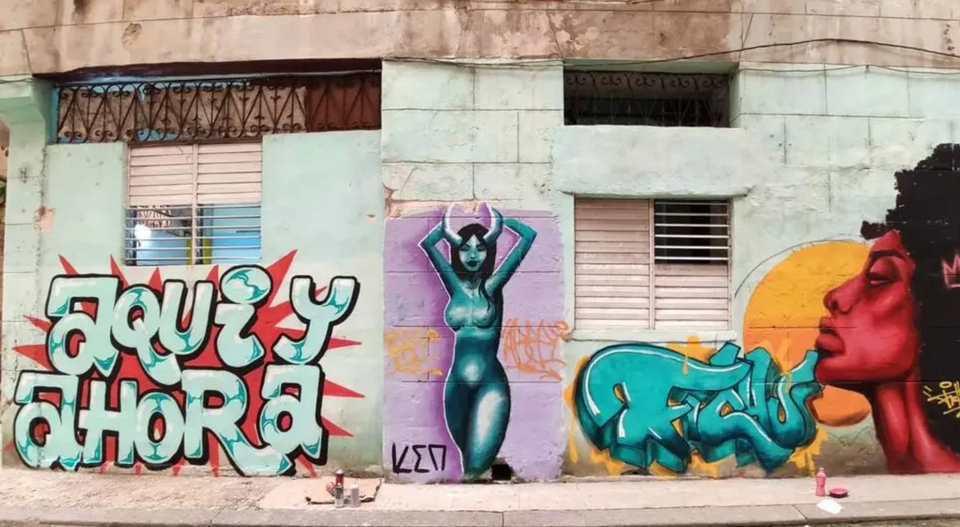
In San Isidro, washing was strung between houses so tired I wondered how they were still standing. With a young population and no government investment, the barrio had become a hotbed of graffiti – and civil disobedience. In 2018, a group of artists started a movement here to protest Decree 349, a law requiring any artistic activity to be authorised in advance by the Cuban culture ministry. Several of the movement’s leaders are still in prison.
While J, C and The Freaks began marking out a facade that must have been at least 500-years-old, the streets of San Isidro sucked me in. Murals depicting bandana-clad protestors holding bombs surveyed me unblinkingly.
I peered hopefully into a front-room shop. Several days of hangover had left my mouth as dry as the piles of grit that had blown in from the street to settle in its corners. The old boys drinking rum from plastic cups turned to stare.
Tienes agua? I asked, bolstering my fledgling Spanish with the ubiquitous hand gesture of a lifted bottle. The owner shook her head.
Solo ron (only rum). It was the fifth shop I’d tried. I shrugged, took a litre of rum and as many cigarettes as I could carry and headed back into the sagging streets of Old Havana.
Back at the site, the crew were gradually stretching the words ‘Aqui y Ahora’ (Here and Now) across the length of the building. I handed round the bottle. Someone brought down a sound system and reggaeton drowned the man hawking tamales from his handcart. Women carried buckets of washing onto their stoops to watch and kids signed their names on the wall in wobbly paint.
****
With the internet – which had arrived in the country less than two years ago – only available in a few public plazas, Google Maps and Translate were useless. From ordering food to choosing where to sleep, I had to rely on J and C for everything. C and I made love a few times on mattresses on strangers’ floors. It wasn’t how I remembered.
****
On another street corner that smelled of paint and rain-drenched concrete, my period arrived unexpectedly. A woman called Aurora – who had hot girl aloofness down to an art and was driving J crazy with it – took me home and gave me a pair of clean knickers. We took hits from a homemade bong and she smeared my mouth with brown lipstick, while her dad watched Cubavision (the government’s cable TV channel) in the front room. Later, with C translating, she told me she’d taken part in the protests that rocked Havana in 2021. It was the most widespread civil disobedience the country had seen since the Communist revolution. Armed police beat her then threw her in jail for three weeks.
The others arrived including M, a doctor who’d taught himself English by listening to The Beatles. As we chatted, I realised I’d barely spoken for days. His mother and grandmother had finally saved up the 10,000USD needed to pay traffickers to smuggle him into the USA, knowing they’d never see him again.
****
Sunrise on the Malecon. C and a long-limbed girl danced salsa, their skin spun gold. She was vibrant as a comet, her eyes dark magnolias just visible below a knife-edge fringe.
It’s totally cool, I lied, you should go for it. They walked away hand in hand. I wondered what I should have done differently: not complained about the heat, needed less sleep, been sexier.
How do you feel? J asked, nodding at their retreating figures.
Yeah a bit awkward but that doesn’t mean he’s done anything wrong. I had entered a new zone where the glimmering surface of the sea, thick exhaustion and ebb of voices I couldn’t understand enclosed me in an empty limbo.
****
Back on the boat that night, some primordial instinct wouldn’t let me sleep. We were once prey and my solar plexus remembered. Our bones rested among those of impala and pampas deer. On stormy nights like this we huddled in cracks in the rock, aware of monsters stalking just beyond the lip of the light. I sat on deck and smoked cigarette after cigarette, my mind a little feverish butterfly.
During the period in which I wrote this, I determinedly dismantled many of the belief structures I’d held up until that point. Now, four years on, I’m in the process of piecing them back together again, reordering them into something that feels just as solid but with a little more breathing room.
I’m so grateful to you for accompanying me for 10 issues of this newsletter. Those who are here for the adventure travel tips and travel-themed essays, this may be the time to get off the ride. For those of us in the Northern hemisphere, Spring is coming. I’m looking forward to introducing a fresh approach to my work when I emerge from my cocoon.
Sending strength and solidarity to all in Cuba.
Love,
Imogen x

March wayfinding: provisions for the month to come
Travelling The Thames Sailing Barge Trust is a community of volunteers who maintain two rare 19th-century sailing barges, the sort that were once found in their thousands around the Thames Estuary but are rapidly disappearing. Every summer they host a few public cruises to raise funds and I’m excited to be joining one in a few weeks time.
Reading Romanticism: a very short introduction by Michael Ferber explores the rising prestige of the poet, Romanticism as a religious trend, Romantic philosophy and the condition of women during the 19th-century. I’m really enjoying drawing parallels between Romanticism/industrialisation and the resurgence of nature writing we are seeing today during the tech boom.
Listening British craft is also having a revival. The Material Matters podcast episode with James Fox, author of the book Craftland, discusses the relationship between handmaking/digital culture, the importance of tacit knowledge and how craft can help us to create a more sustainable future
Learning British-born Cypriot poet Anthony Anaxagorou runs poetry workshops online called Pick Your Fighter, where he breaks down the most common ‘moves’ poets make into 16 simple categories. His monthly event at the Southbank Centre, Out-Spoken, brings the hottest UK and international poets to perform alongside world-class musicians every month.
Homemaking Living in a medieval building with narrow stairs means that some things have to be custom made – something I’ve started to think of as an unavoidable ‘charm tax’, as well as an opportunity to support small makers. This month, I commissioned a dining table and bench from Folkhaus, a furniture studio based in Frome, Somerset.

Of course, you can always buy my book
The Ethical Traveller: 100 Ways To Roam The World Without Ruining It
Member discussion